Basic story structures

According to Pixar (in part),

Once upon a time there was ___. Every day, ___. One day ___. Because of that, ___. Because of that, ___. Until finally ___.


Jim Shooter,

Introduce the character

Little Miss Muffett

Introduce the status quo

Sat on a tuffett, eating her curds and whey

Establish the antagonist and conflict

Along came a spider

Build suspense

And sat down beside her

Rising conflict

And frightened Miss Muffet

Resolution of the conflict and story denouement all at once

Away


Algis Budrys,

  1. A character,
  2. in a situation,
  3. with a problem,
  4. who tries repeatedly to solve the problem,
  5. but repeatedly fails, (usually making the problem worse),
  6. then, at the climax of the story, makes a final attempt (which might either succeed or fail, depending on the kind of story it is), after which
  7. the result is restated in a way that demonstrates it was, in fact, the final result


Geoffrey A. Landis,

  1. Require the character to make a choice,
  2. show that choice by actions, and
  3. allow actions to have consequences.


and Steve Barthelme: “A story follows an active character through emotionally charged experiences which changes him or her.”

Posted in Writing tools | Leave a comment

Scene setup: a form to get you started

Scene Setup

Time and place:

Props:

Five senses (sight, smell, sound, touch, taste):

Characters:

Dialogue:

Actions:

Large:

Small:

Inner life: Motives, agendas, wants, choices:

Conflict/tension:

Exit line:

Causal relationship with the next scene:

(This is a variation on Robert J. Ray’s form from The Weekend Novelist.)

Posted in Writing tools | Leave a comment

Don’t Do This

Jerome Stern’s Making Shapely Fiction is full of good advice. Here’s an excerpt that will save you years of work.

Posted in Writing tools | Leave a comment

Workshop

This PDF contains anonymously submitted work for the review of English 2250 students.

Posted in Assignments | Leave a comment

Conflict, connection, and pattern

Janet Burroway’s Writing Fiction describes a way of adding tension to poetry and prose without using power shifts and conflict. This PDF will give you a sense of what she’s talking about.

Also, consider this sestina and the instructions for writing your own examples.

Posted in Writing tools | Leave a comment

“Johnny Cash,” “Adelso,” and “Lizard”

Thinking about the poetry criteria attached to the syllabus, read “Johnny Cash,” “Adelso,” and “Lizard.” Also, consider these contemporary sonnets.

Posted in Assignments | Leave a comment

The scale of abstraction

The writing that interests readers in poems or prose is usually low on the scale of abstraction. It is writing that presents concrete details and avoids abstract generalities or commentary. Abstractions are necessary in some cases, but more often interesting writing avoids them. When the details are presented so that they remind readers of their senses and perceptions, they are more engaging. When the details are presented so that they evoke the memory of senses and perceptions and the importance of those details are obvious to a character or persona, they are even more engaging and interesting for readers.

Consider the following from Western Wind: An Introduction to Poetry: “Instead of the abstraction nutriment, one might use such an image as ‘juicy cheeseburger on dark rye with dill pickle.’ What concrete images can you think of that might be used to stand for the following abstractions: exercise, amusement, wretchedness, locality, velocity, attraction, dryness, spiciness, agitation, deception, insufficiency, authority, success?”

Think about the following quotations as you work:

Elias Canetti . . . had declared that “Among the most sinister phenomena in intellectual history is the avoidance of the concrete.” He means that in ignoring what is the “closest and most concrete” of realities, we are endangering the future of humanity. When generals and politicians refer to the deaths of innocent civilians in wartime as “collateral damage,” they avoid concrete images of mangled bodies, obscuring the truth with abstraction. –John Fredrick Nims and David Mason

We think in generalities, but we live in detail. –Alfred North Whitehead

The artist seeks out the luminous detail and presents it. He does not comment. –Ezra Pound

Here is one example of moving down a scale of abstraction:

Clothing

Men’s clothing

Formal men’s clothing

Suits

Suits that I’ve seen

Suits that I’ve worn

The suits I’ve worn that my father paid for

The suit that my father gave me that he bought when he was my age

The suit my father gave me that he wore to church and that I wore to clubs

The pale blue suit, almost white, that he gave me

The pale blue suit with one low button on the long tight jacket, fat linebacker shoulders, and thick cuffs on baggy trousers

The suit lined with smooth silk but mostly made of cheap, tough as burlap, cotton

The suit that smelled a little like worry, like smoke, like apple pollen

The suit she liked so much that she danced with me

The suit I wore while we kissed behind the building

The suit with Isaiah 74:3 handwritten in sharp letters on a card in the breast pocket


Write a similar example of your own.

Posted in Writing tools | Leave a comment

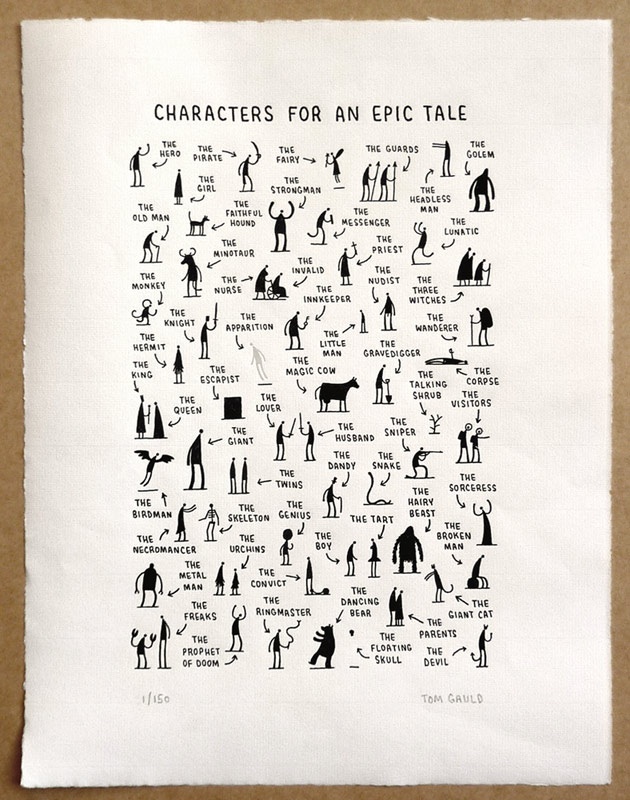
Visual triggers for writing

Here are two PDFs that can help you start writing poetry or prose. Both are intended to evoke ideas. The first is by Tom Gauld. You can buy copies online.

The other is a postcard that came in my mail. Consider “reading” each from left to right, but also right to left, bottom to top, and other orders you find interesting.

How might other senses help you start writing?

Posted in Writing tools | Comments Off on Visual triggers for writing

Summer plans

We’re reading The River at the Center of the World so we can feel prepared for our big trip.

Posted in More than you want to know | Leave a comment

Searching Moby-Dick

Looking for a searchable electric edition of Moby-Dick? You’ve found it.

Posted in American literature | Leave a comment